 Kraterion by

Kraterion runs AI agents on storage you own, and records every run
Kraterion is a runtime for AI agents you can audit, on storage you own. Files sit on Walrus, owned by your Sui account, behind a standard S3 interface, and every agent run is recorded for replay. Nano Soft built the first version in about 6.5 weeks for Sui Overflow 2026, where it took 1st place in the Walrus track.
- 1st place, Walrus track, Sui Overflow 2026
- Private beta
- Platform
- Web, on Sui and Walrus
- Category
- AI agent runtime and storage
- Recognition
- 1st place, Walrus track, Sui Overflow 2026
- Year
- 2026
- Role
- Product, design, build, launch
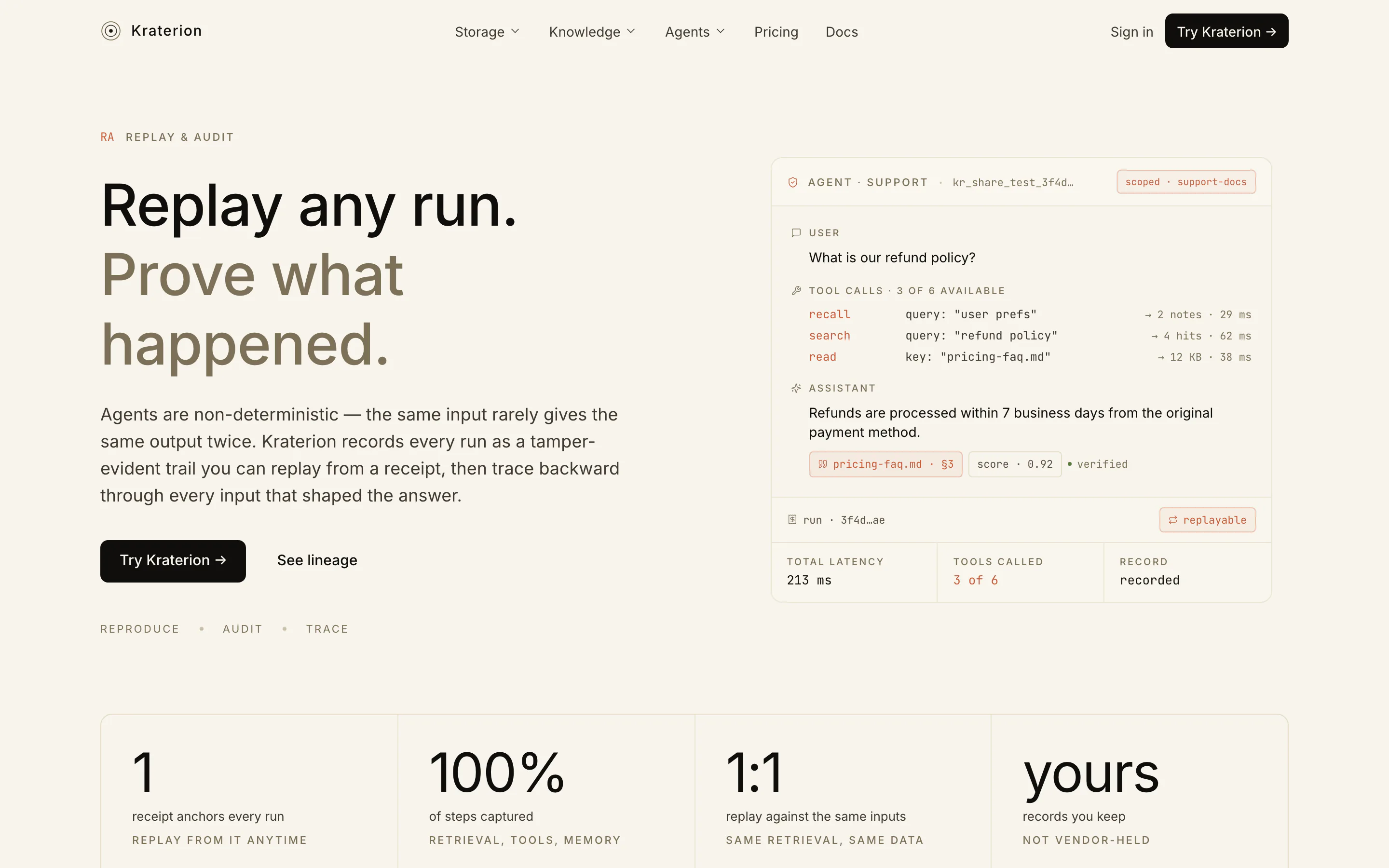
A recorded run: the question, each tool call and a cited answer.
Challenge
Storage and AI agents both ask for blind trust
Cloud storage asks you to trust the provider. Cancel and the files can go. Get locked out and they are gone. The provider can read what it stores, and leaving means paying to copy everything out.
AI agents add a second layer of trust. They reason over that data, the same input can give a different output, and the trace usually lives in a vendor's database. You cannot prove what an agent read or how a past answer was made.
The build had its own limits. We had about 6.5 weeks from kickoff to the Sui Overflow 2026 deadline. Walrus prices storage per object, up front, which does not match the per-gigabyte bill developers expect. And in July, on the way to mainnet, Sui switched off the public interface our chain layer used, so we moved it to the newer one.
Approach
A familiar surface with the chain underneath
We kept everything a developer touches familiar: the S3 API, Google sign-in and an OpenAI-compatible endpoint. The chain sits only where promises used to live. Users never handle crypto tokens; the platform pays storage and transaction fees from a shared reserve.
Ownership is enforced by cryptography, not by a privacy policy. Each file is encrypted before it is stored, and decryption keys are only released while your on-chain bucket allows it. Revoking access is one transaction, after which the platform cannot read your files.
To make decentralized storage bill like normal storage, we pooled it: each project gets one storage pool, uploads use capacity and deletes free it. Every agent run records its inputs, retrievals, tool calls and output, stored on Walrus and anchored on Sui. We are open about limits too: the on-chain package is marked unaudited, and roadmap items say coming soon.
Pool the storage, meter the pool
One storage pool per project turns Walrus's per-object pricing into the per-gigabyte bill developers expect.
Never break the guarantee
If a feature could only exist by weakening ownership, we looked for a different design.
Chain as the source of truth
The database is only a fast mirror of on-chain state, kept in sync by a background service.
Plain words for verifiability
The product talks about debugging, reproducing, auditing and owning, and keeps crypto language in the deep docs.
What we built
Storage, knowledge and agents in one runtime
Kraterion has three layers: storage you own, knowledge bases that cite their sources, and agents whose runs you can replay. Developers reach them through APIs they already use.
S3-compatible storage you own
Standard S3 tools work unchanged; files are encrypted, stored on Walrus and owned by your Sui account.
Access you can revoke
One on-chain transaction stops the platform decrypting your files, and cancelling the service does not delete them.
Knowledge bases with receipts
Hybrid search over a bucket, and every answer carries hashes of the passages it used.
Agents with replayable runs
Each run records the model, inputs, retrievals, tool calls and output, and can be replayed and traced.
MCP server and chat widget
The same agents work in Claude Desktop and Cursor over MCP, or on any site with one script tag.
Per-agent credentials
Each agent gets its own scoped, revocable identity; revoke it and its file and memory access stop together.
Outcome
1st place in the Walrus track, then mainnet
Kraterion took 1st place in the Walrus track at Sui Overflow 2026, announced by the Sui Foundation on 27 August 2026. The hackathon drew 747 projects from 58 countries, and Walrus was its most-entered track.
The Walrus Foundation featured Kraterion as a builder story and called the pooled-storage design "the decision worth copying". Kraterion has been live on Sui mainnet since 1 September 2026 and is in private beta.
- Recognition
- 1st place, Walrus track, Sui Overflow 2026
- Built in
- About 6.5 weeks
- Status
- Private beta, live on Sui mainnet
Screens
Inside Kraterion
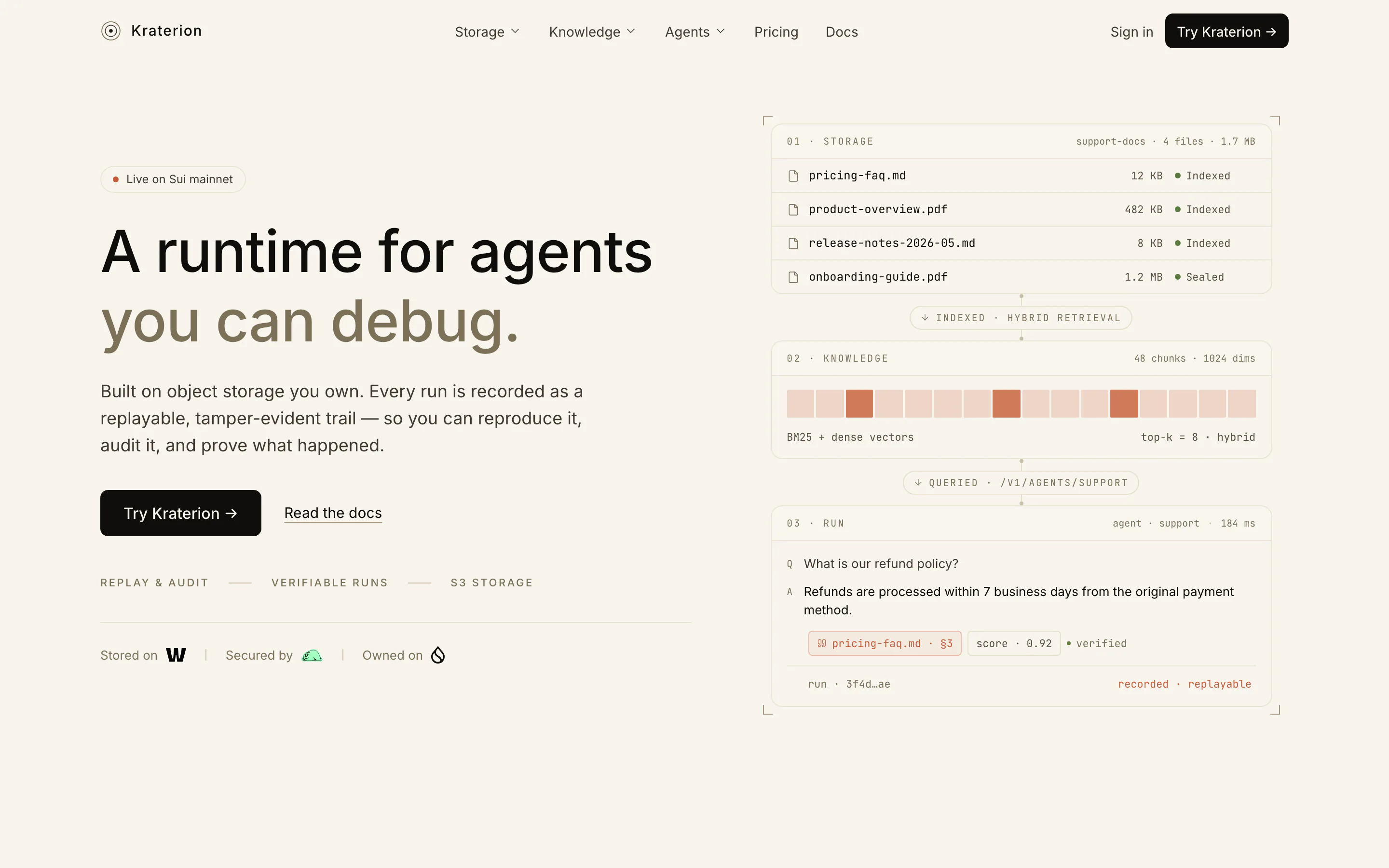
Files in storage, indexed into knowledge, then a recorded run that cites its source. 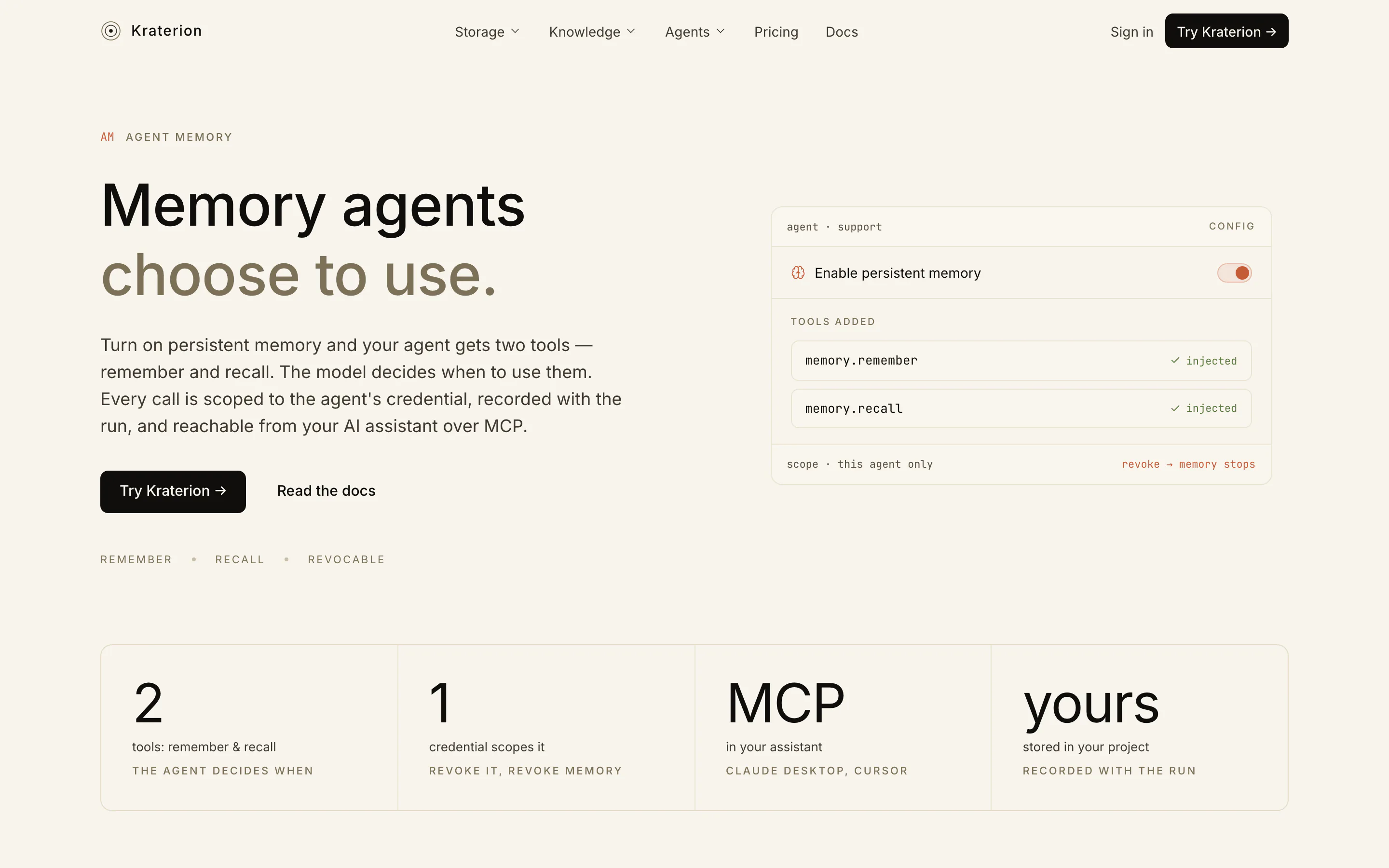
Agent memory is opt-in, with two tools the agent chooses to use. 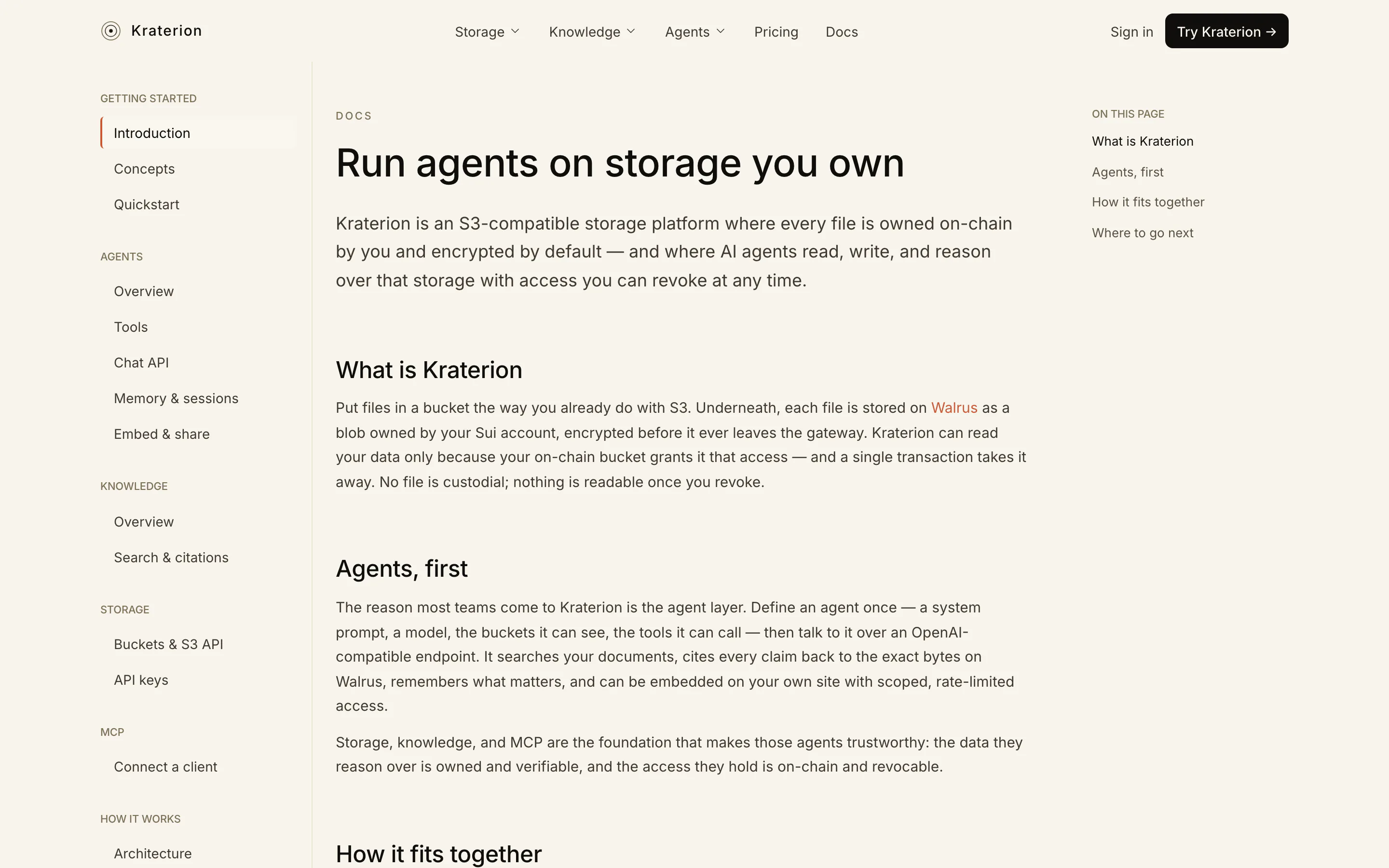
Documentation for running agents on storage you own.
Want a product like Kraterion?
A few lines are enough: what the product is, where it stands and when you need it. We reply to every message within 2 working days.
- hello@nano-soft.tech
- Reply
- Within 2 working days
- Based in
- Bucharest, Romania